For everyone who thought the longsword was a European story
China Had a Longsword.
This Is the Manual.
The Chaoxian Shifa: twenty-four postures of the two-handed straight sword, preserved in the Wubeizhi, the great Ming dynasty military encyclopaedia of 1621, one of the oldest surviving records of straight sword use in Chinese military literature. This course teaches the complete method, posture by posture, from a teacher who fences it.
The historical overview, all twenty-four postures. Lifetime access.
No local teacher required.
The two-handed jian
The Shuangshou Jian is a two-handed straight sword: longer and heavier than the single-handed jian, with a grip short enough that the hands sit close together. That grip changes everything about how the weapon moves. The cuts are quicker and snappier than the pressing cuts of the long-gripped dao systems, many movements are done with one hand, and the weapon rewards precision over force.
Its method survives in the Chaoxian Shifa (朝鮮勢法), the two-handed straight sword section of the Wubeizhi (武備志), the Ming dynasty's monumental military encyclopaedia. Twenty-four postures, each recorded with an image and a terse description: a documented, transmissible system, not a modern invention.
A manual is not a teacher
If you've ever tried to fence from a period source, you know the problem. The Chaoxian Shifa gives you one image per technique, brief descriptions, and terminology that doesn't always translate cleanly. Four hundred years sit between you and the hand that wrote it.
This course closes that distance honestly. Every posture is taught for what it does, with the mechanics, footwork and tactical purpose worked out in full. Where Scott Rodell makes an interpretive choice, he explains why. Where another reading is equally valid, he says so. If you've spent time in the manuscript traditions, you'll recognise what that honesty is worth: you're not being sold a fantasy of certainty, you're being taught a method by someone who has pressure-tested his reading of it with steel in hand.
WHAT'S INSIDE
The complete Chaoxian Shifa, posture by posture
The Historical Overview
The manual, the weapon and the tactical framework before a single cut: what the Wubeizhi is, where the Chaoxian Shifa sits inside it, and how this system thinks. Work through this first; it makes everything after it easier to absorb.
The Twenty-Four Postures
Every posture of the Chaoxian Shifa, one by one and in order. Each lesson gives you the source image and text, the interpretation and its reasoning, the mechanics and footwork, and then the posture applied against a partner, so every technique arrives with its fighting purpose attached, not promised for some later course.
Course Completion Credential
Finish the full progression and earn the Academy's Shuangshou Jian completion credential.
You also join the Academy community, where students around the world share training footage, find partners and ask questions.
WHO IT'S FOR
You fence HEMA longsword.
You know Liechtenauer, maybe Fiore, and you've wondered what the same questions look like answered by a different civilisation. This is that answer: a period military source, a two-handed straight sword, and a method you can cross against everything you already know.
You come from jianfa.
You have the single-handed jian in your hands, and the two-handed weapon has been calling. You'll recognise a great deal here, and the short grip will rewrite the rest: quicker cuts, different leverage, one-handed transitions the single sword never asked of you.
You come from the two-handed dao systems.
Miaodao or dadao, you already think in two hands, but the straight double-edged blade answers differently: pay attention to where the mechanics diverge, because that contrast is half the education.
You train alone.
The postures are a complete solo study, taught to be worked without a partner, and the Academy community can help you find one when you're ready to test your reading against someone else's.
Learn from a lineage, not a hobbyist
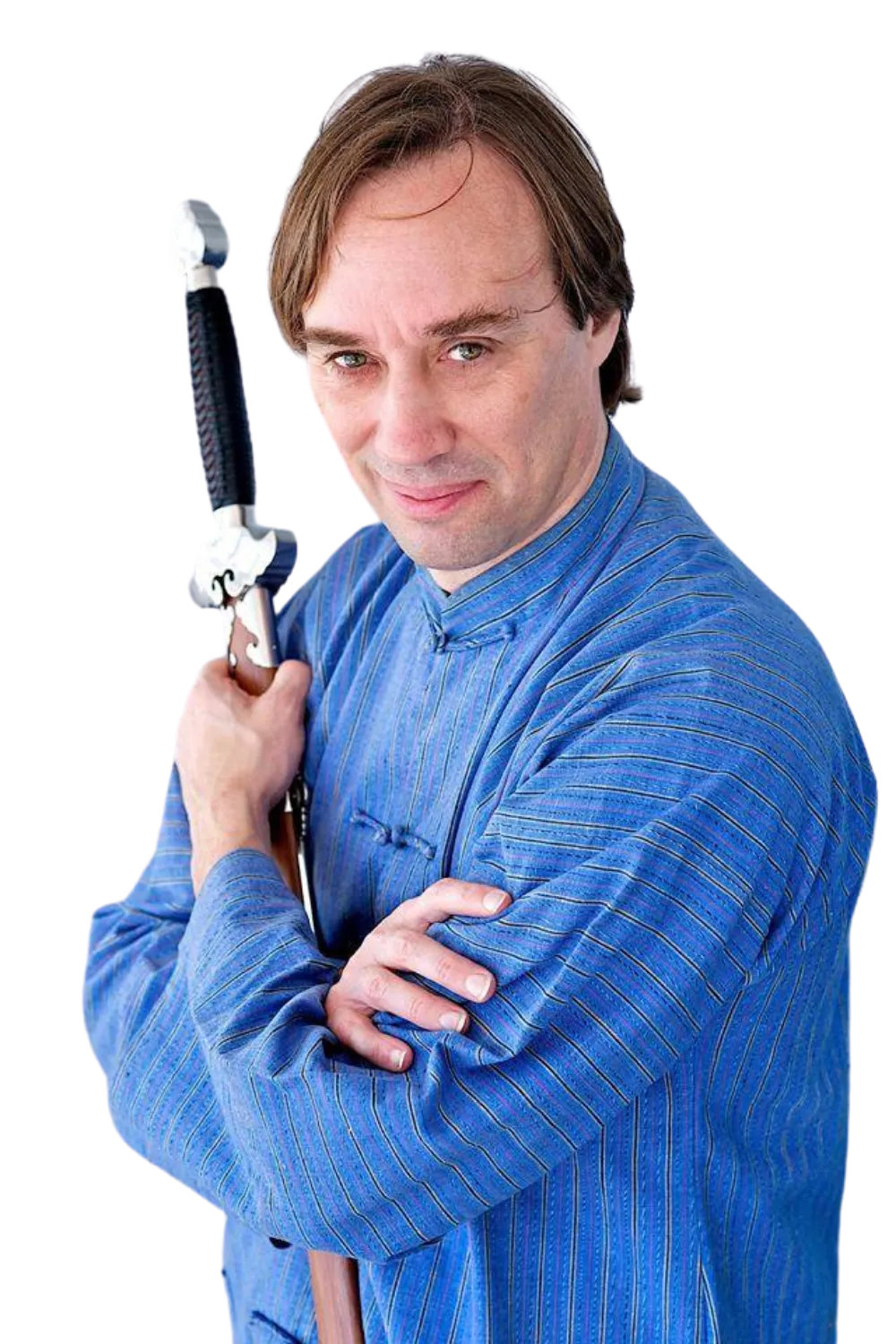
Your instructor is Scott M. Rodell, who has spent more than thirty years researching, teaching and pressure-testing Chinese swordsmanship: training students across six continents, authoring standard works in the field, and testing historical methods where they count, in full-contact free swordplay and against sharp-blade cutting.
When Scott Rodell teaches a posture from this manual, it's not an armchair reconstruction. His reading has been tried against resisting opponents, refined, and taught to thousands of students.
Frequently Asked Questions
Is this beginner friendly?
Yes, with a caveat. The course teaches from the historical overview forward and assumes no prior sword training, but it's a study of a period source, and it rewards the kind of student who enjoys working carefully. If you have jianfa, HEMA or two-handed dao experience, you'll move faster.
Do I need a partner?
No. The posture work stands entirely on its own, and that's most of the study. Every lesson also includes the partnered applications, so when you do have a partner, the material is waiting, and the Academy community can help you find one.
How is this different from the Yangjia Michuan Taiji Jian course?
Different weapons, different sources. The Michuan is the Yang family's single-handed taiji jian transmission; this is the two-handed military jian of a Ming dynasty manual. If you want the taiji sword art, start there. If you want China's longsword, this is it.
What exactly do I get?
Lifetime access to all 44 lessons across four modules in your Academy portal, the illustrated history PDF, the completion credential, and membership of the Academy community. One payment, no subscription.
If I join a membership later, do I keep this course?
Yes. Standalone courses are yours for life, whatever you do afterwards.
What's the refund policy?
A 30-day money-back guarantee. If the course isn't for you, email us within 30 days for a full refund.
Four Hundred Years Old. Still Waiting to Be Fenced.
The Chaoxian Shifa survived the fall of a dynasty to reach you: twenty-four postures of the Chinese longsword, taught complete, honestly, by a swordsman who has tested every reading.


Link
CONTACT US
(703) 846-8222
Academy of Chinese Swordsmanship, 3543 Marvin Street
Annandale, VA 22003
Copyright 2026. The Academy of Chinese Swordsmanship. All Rights Reserved.