The fastest way into Chinese two-handed saber
Shuangshou Dao: The Saber Form of the Ming Dynasty's Greatest General
A living reconstruction of General Qi's battlefield long saber form, rebuilt from rare Ming and Korean military manuals and pressure-tested in modern swordplay. Built to make soldiers dangerous quickly, it will do the same for you: 14 lessons, the complete form road by road, its applications, and the basic cuts that power it.
The historical overview and form. Lifetime access.
No local teacher required.
The general who wrote the book
Qi Jiguang is the most celebrated general of the Ming dynasty: the commander who broke the wokou pirates on the southern coast, held the northern frontier, and wrote the military manuals that shaped martial training across East Asia for centuries. When his soldiers needed to face longer weapons and mounted opponents, he armed and trained them with the long two-handed saber.
His saber method was built the way everything Qi built was built: simple, linear, nothing a farmer-turned-recruit couldn't learn fast and use hard. And it survived, recorded in rare Ming and Korean military manuals, because Qi's training methods were valued far beyond China's borders.
This course is a living reconstruction of that form: the historical record worked back into a training method, tested with steel in hand, and taught road by road the way it's built to be learned.
The famous name, on the right weapon
Here's an irony the internet keeps getting wrong. Qi Jiguang is endlessly credited as the father of the miaodao, a claim that doesn't survive contact with the sources: he called his weapon the changdao, and his form was its own system. So while his name gets attached to weapons he never taught, the form he actually recorded goes almost entirely untaught. This course is that form.
WHAT'S INSIDE
The complete form, road by road
The Form (11 lessons)
From the weapon and the first two movements through all three roads of the form, the guarded retreat, and the completion. The applications are taught alongside the roads, so you always know what the movement in your hands was built to do.
Q&A and Review
A full review session answering the questions students actually hit partway through the form, so the second half of your study is cleaner than the first.
Basic Cuts and Combinations (2 lessons)
The cutting mechanics behind the form, isolated and combined, to sharpen everything the roads taught you.
Course Completion Credential
Finish the full progression and earn the Academy's completion credential for Qi Jiguang's Shuangshou Dao form.
You also join the Academy community, where students around the world share training footage, find partners and ask questions.
WHO IT'S FOR
You're brand new to sword work.
This is the most beginner-friendly course in the Academy: a compact soldier's system designed four centuries ago for people who had never held a sword and needed to be capable fast. Fourteen lessons, weeks not months, and a real battlefield form at the end of it.You train the dadao or miaodao.
You already love the two-handed saber; this is an ancestor of everything you train, from the general whose manuals started the story. The mechanics will feel familiar, and the differences will teach you where your own system came from.
You're here for the history.
You've read about Qi Jiguang, maybe read the manuals themselves, and you want the material in your hands instead of on the page. This is the rare chance to train what the record preserves, from a teacher who explains his reconstruction rather than hiding it.
You train alone.
The form is a complete solo study, the applications are there for when you have a partner, and the Academy community can help you find one.
Learn from a lineage, not a hobbyist
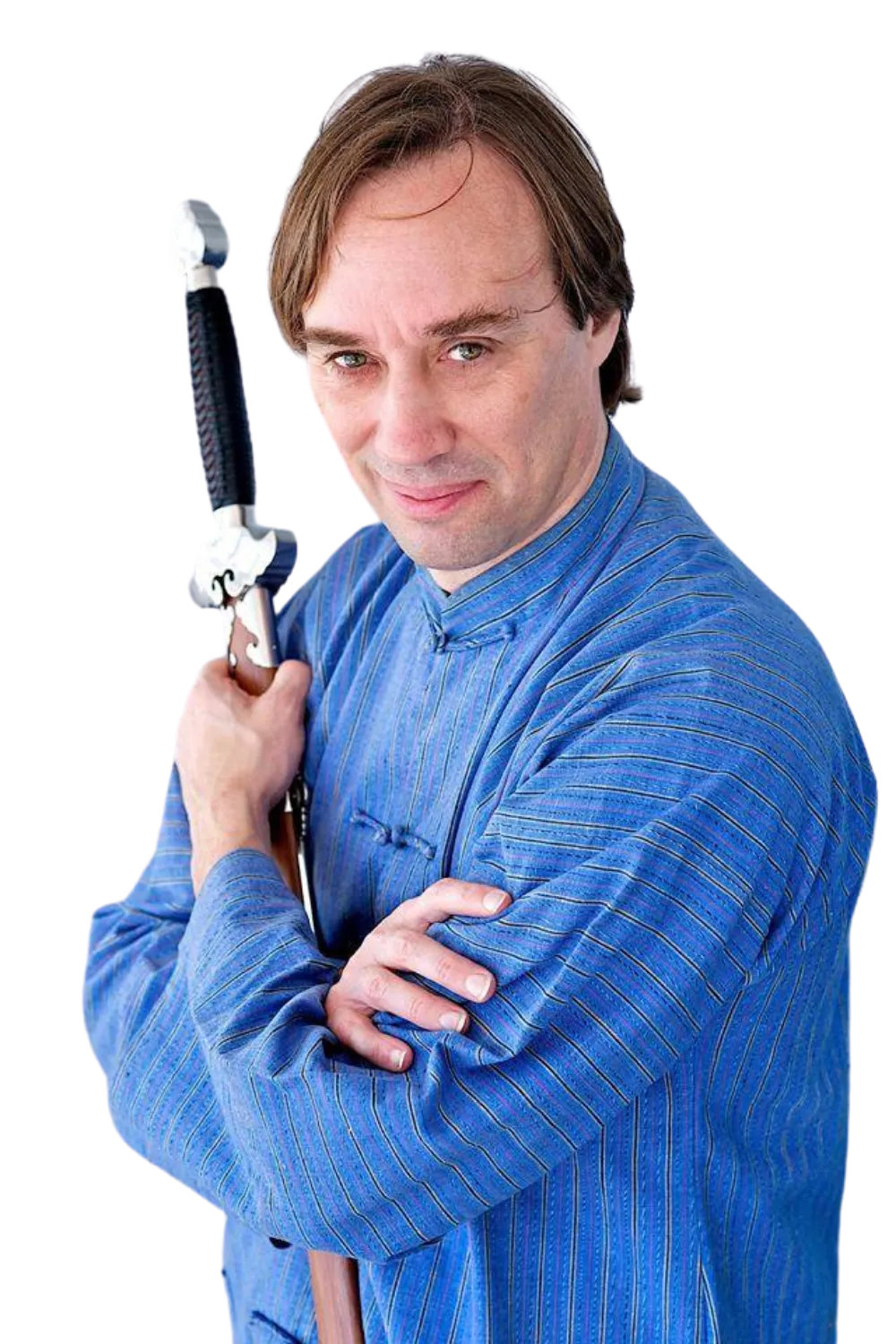
Your instructor is Scott M. Rodell, who has spent more than thirty years researching, teaching and pressure-testing Chinese swordsmanship: training students across six continents, authoring standard works in the field, and testing historical methods where they count, in full-contact free swordplay and against sharp-blade cutting.
When Scott Rodell teaches a reconstruction, he shows you the reasoning as well as the result. His reading of this form has been tried against resisting opponents, refined, and taught to students worldwide.
Frequently Asked Questions
Is this beginner friendly?
The most beginner-friendly course we offer. It was designed to train complete novices quickly, and it still does. No prior sword experience needed.
How long will it take to learn?
The form is compact by design. Training a few sessions a week, most students can run the complete form within weeks, then spend as long as they like refining it with the cuts, combinations and applications.
Do I need a training partner?
No. The form is a complete solo study. The applications are there for when you have a partner, and the Academy community can help you find one.
Didn't Qi Jiguang invent the miaodao?
No, and the confusion is exactly why this course exists. Qi called his weapon the changdao, and his recorded form is its own system.
If I join a membership later, do I keep this course?
Yes. Standalone courses are yours for life, whatever you do afterwards.
What's the refund policy?
A 30-day money-back guarantee. If the course isn't for you, email us within 30 days for a full refund.
How is this different from the Practical Dadao course?
Three centuries and a different fight. The dadao is the short Republican-era chopper built to meet a bayonet; this is the long Ming battlefield saber built for reach against pole weapons and cavalry. Many students train both, and the contrast is half the education.
His Recruits Learned It in Weeks. So Will You.
General Qi built this form to turn beginners into swordsmen fast, and four hundred years later it hasn't lost the knack. Fourteen lessons, the complete form, and the general's own method in your hands.


Link
CONTACT US
(703) 846-8222
Academy of Chinese Swordsmanship, 3543 Marvin Street
Annandale, VA 22003
Copyright 2026. The Academy of Chinese Swordsmanship. All Rights Reserved.