
I Still Want to Fight. I Just Don't Want to Wreck Myself
I'm coming up to 50, and something I've been thinking a lot about recently is what nearly 40 years of martial arts does to your body.
I started Karate when I was nine. Over the years, I've trained in everything from Karate, Judo, and Muay Thai to Kung Fu, Taijiquan, Sanda, and Chinese swordsmanship, and I've also spent five years working on the doors. I've done plenty of hard sparring, and I've always been a big believer that if you're learning a martial art, at some point you need to train against somebody who is actually trying to hit you.
I still believe that.
But there's a side to full-contact martial arts that I don't think we talk about very much.
A lot of my friends who did boxing, kickboxing, grappling, and other hard-contact martial arts are now around my age. And a lot of them are in pain.
Not temporarily injured. I mean things that will probably stay with them for the rest of their lives.
Bad knees, bad backs, shoulders that don't work properly, arthritis, old injuries that have gradually become permanent problems.
That's not me saying everyone who boxes or grapples is going to end up wrecked. Obviously they aren't. But when you've been around martial arts for as long as I have, you do start noticing it.
I've got my own version of it.
I've had problems with sciatica for the best part of ten years. It's finally getting to the point where I feel like I'm coming out the other side, and I really don't want to go back.
Interestingly, it wasn't until I cut right back on the hard sparring that things really started to change.
That wasn't the only thing. I also had three cortisone injections into my sacroiliac joint, which finally seemed to get things under enough control that I could start moving properly again. From there I've put a lot more time into mobility and generally looking after the bits that I'd spent years taking for granted.
I can't prove that hard sparring caused the sciatica, and I'm not claiming that stopping it magically fixed me. Bodies aren't that simple. But I can't ignore the fact that once I stopped repeatedly battering myself and started putting some effort into mobility and recovery instead, things began moving in the right direction.
More importantly, for the first time in probably ten or fifteen years, I'm actually enjoying moving again.
I'd almost forgotten what that felt like.
I'm starting to get back to the place I was in during my late twenties and thirties, when I was really getting into my Taijiquan practice. Training wasn't something I had to persuade myself to do while working around whatever happened to hurt that day. I wanted to move.
I'm getting that back.
I'm finding myself bouncing out of bed in the morning, actually wanting to train. Wanting to do some Taiji, work on my mobility, pick up a sword and move around.
For me, that's probably been the biggest change of all. It's not just that I'm hurting less. I'm enjoying having a body again.
That's changed the way I think about my own training.
I don't need to find out if I can take a punch anymore
When you're younger, I think hard training answers some useful questions.
What happens when somebody actually hits me?
Can I keep going when I'm tired?
Can I make this stuff work when the other person doesn't want me to?
Am I going to freeze when someone comes at me?
Those are important questions if you're practising a fighting art.
I've answered them.
I've been hit plenty of times. I've been kicked, thrown, punched and choked. I've sparred hard. I've competed. I've dealt with violence outside training as well.
I don't think another ten years of getting smashed around will teach me anything about myself that I don't already know.
What it might give me is another knackered joint.
The problem is that I don't want to give up the other part of it.
I still like fighting.
In fact, if I'm honest, part of me still absolutely loves the fight. That bit hasn't gone anywhere, and I don't think it ever will. It's probably the part of martial arts I'd find hardest to give up completely.
Swordsmanship gives me that
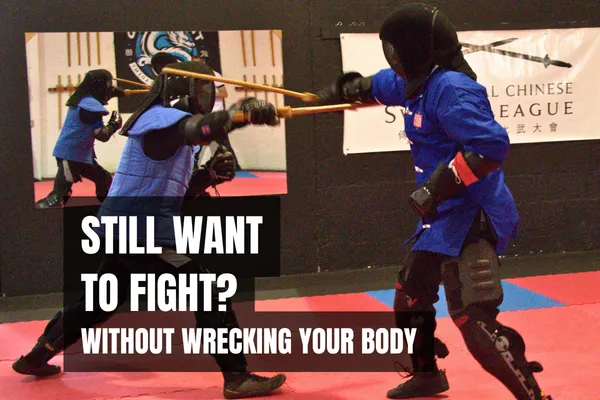
The more I've focused on swordsmanship, the more I've realised it gives me a lot of what I used to get from hard unarmed sparring.
Someone is standing opposite me and trying to hit me.
They don't want my technique to work. They're trying to trick me. They're trying to control the distance and timing. If I make a mistake, they take advantage of it.
That's the bit I've always enjoyed.
And you can do all of that without having to kick the shit out of each other.
Obviously sword sparring isn't harmless. We spar properly, and people get hit. You come away with bruises sometimes. Accidents happen.
But there's a fundamental difference.
If we're boxing and I want to demonstrate that you've failed to defend yourself, I have to hit you.
With a sword, the weapon does a lot of that work for us. I don't need to smash you in the head as hard as possible to know that you failed to defend the cut.
That means we can have a proper competitive exchange where both people are genuinely trying to win without needing the same amount of physical punishment.
And at my age that's becoming increasingly attractive.
Push hands has started filling another gap
I've found something similar with push hands.
Again, I don't mean standing there doing a cooperative pattern and calling it fighting.
Once we start working more freely, I've got another person trying to upset my structure, take my balance, move me and stop me from doing the same to them.
It's physical. There's pressure. Someone is resisting me.
It isn't Sanda, and I'm not pretending that it is.
But it gives me another part of that contact that I don't particularly want to lose.
Between swordplay and push hands, I'm finding that I can still get my full-contact fix without spending the rest of the week feeling like I've been in a car crash.
Twenty years ago I probably wouldn't have cared about that.
Now I do.
I want to still be doing this when I'm 70
I think that's the biggest change in my attitude towards training.
I'm not trying to get through the next ten years of martial arts.
I'm trying to work out how I can do another 20 or 30.
And that changes the calculation.
I don't want to stop sparring because I'm getting older. I don't want everything to become forms, solo practice and talking about applications we never actually test.
That doesn't interest me.
I still want someone trying to beat me.
I still want to get caught when I make a mistake.
I still want that little bit of adrenaline when you're standing opposite someone, and neither of you knows exactly what's going to happen next.
I just don't think I need someone repeatedly punching me in the head to get it anymore.
Maybe that's something we should talk about more in martial arts.
We spend a lot of time talking about how to train harder, how to become tougher and how to push through injuries.
We don't talk nearly as much about what happens 20 or 30 years later.
I'm watching that happen now to people I've known for years.
And I'm experiencing a bit of it myself.
So no, I'm not interested in turning my martial arts into something safe and comfortable because I'm approaching 50.
I still want the contact. I still want the pressure. I still want the fighting.
I'm just becoming much more selective about what I think is worth damaging myself for.
Because I'd quite like to still be doing this when I'm 70.


