
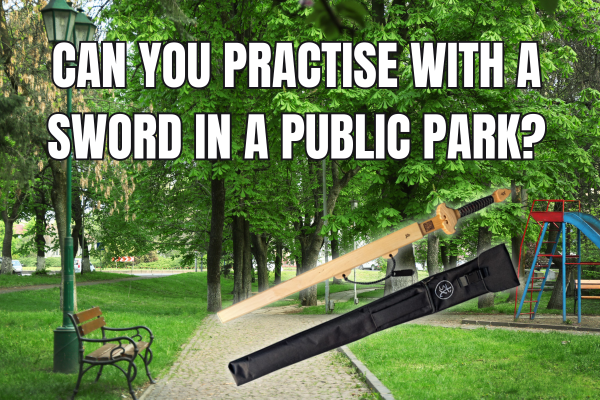
Can you practise with a sword in a public park? A guide for martial artists
In November, Cambridgeshire Police were called to Central Park in Peterborough UK after a member of the public saw a man practising martial arts with what looked like a sword. Officers arrived with a police dog called Ghost, seized three items they described as imitation swords, and gave the man advice. The reports leave open what the swords were made of and what power the police used to seize them. BBC News · Peterborough Telegraph
I think it’s ridiculous that someone can go out to practise a form and come home without their training kit. Plenty of us are up in arms about it. Fair enough. We can think it’s ridiculous all day and it still won’t change the law or what someone sees from across the park.
You might be doing a Kung Fu form with a jian or dao, working through a longsword drill from historical European martial arts (HEMA), or practising a Japanese sword art with an iaitō or a bokutō (also called a bokken, a wooden practice sword). The person walking the dog sees someone with a sword. They don’t know what you’re doing or why. They might call the police. If we want to get on with practising our arts, that’s the situation we have to plan for.
If you want to train in a public park
Personally, I don’t like training martial arts in public. I’m there to practise, and I’d rather get on with it than stop every five minutes to answer questions. If you’d rather train on your own, a private space you have permission to use may suit you better. A quiet corner of a park is still public, and a privately owned site can also count as a public place if the public has access at the time. Criminal Justice Act 1988, section 139
Ask before you go. Email the council’s parks team or whoever manages the space. Tell them which park, where in the park, when you want to practise, what you’ll bring and whether it’s just you or a group. “I’d like to practise solo forms with a wooden training sword on Saturday morning. Is that allowed, and is there a part of the park you’d prefer me to use?” If permission is needed, get it in writing. For an organised club session, check the insurance, do a risk assessment and agree the area with the venue. Peterborough City Council events guidance
Have a look around before you unpack. Stay well away from paths, playgrounds and entrances. Give yourself enough room to finish the whole form without anyone coming within reach, and stop if someone approaches. If the spot is busier than you expected, leave the sword in the bag and practise empty-handed or move the session. I’d keep paired work and sparring at a club venue.
I’ve heard stories about people being stopped over foam weapons used for live action role-play (LARP). I haven’t verified those cases. The practical question still stands. From where a passer-by is standing, can they tell it’s foam? If you can’t find somewhere suitable, you can still practise the footwork or run through the form empty-handed.
Keep the emails handy
Save the written permission or booking confirmation on your phone so you can pull it up without a signal. For a park, keep the reply from the parks team or landowner, with any conditions they gave you. For a hall or club, keep the booking or organiser’s confirmation. If you’ve already spoken to the local police about the session, keep any reply or reference number they gave you too.
If an officer asks what you’re doing, it helps to be able to say, “I’m practising solo forms with a wooden training sword. The parks team said I could use this spot. I have their email on my phone if you’d like to see it.” Wait for the officer’s direction before reaching for your phone. A written reply gives them something they can check there and then. They may still ask you to pack up and move on. Permission to use the space and any correspondence with police can help explain the circumstances. The law on carrying the equipment still applies. GOV.UK guidance on carrying knives and weapons
What the law says in England and Wales
Blades and sharp points. Section 139 of the Criminal Justice Act 1988 covers having an article with a blade or a sharp point in public. A blunt metal practice sword can still count. If charged, you can put forward a defence of good reason or lawful authority. A genuine training session may support that defence, but a court decides whether the reason was good enough in the circumstances. Criminal Justice Act 1988, section 139 · GOV.UK guidance
Offensive weapons. There’s a separate rule for items made or adapted to injure someone, or carried with the intention that they be used to injure someone. Even a wooden sword can fall under that rule if it meets the test. The defence here is lawful authority or reasonable excuse. Prevention of Crime Act 1953, section 1 · Crown Prosecution Service guidance
If you train with a dao or another curved sword, check the separate restrictions for curved blades of 50 cm or more. The measurement is in a straight line from the top of the handle to the tip. The restrictions can apply at home too, and there are specific defences, including for blunt curved swords. Offensive Weapons Order, Schedule · Criminal Justice Act 1988, section 141
Getting your kit to training and back
In my experience, it’s easy to think about what happens once you get to the venue and forget that you still have to get there and back with a sword.
Check the session and the kit before you leave. Confirm that the venue allows the equipment and take what the session calls for. If you’re unsure whether you can lawfully carry a particular sword, get advice before taking it out. If you can borrow what you need at the club, that’s one less thing to carry. GOV.UK guidance
Pack it so it stays put. Use a closed equipment bag or case. Secure the sword in its scabbard if it has one, and secure the bag or case in the car if you’re driving. Leave it packed until you’re in the training space, and pack it again before you head home.
Have the session details handy. Keep the venue name, class time and booking confirmation or instructor’s contact details on your phone. If you’re lawfully carrying metal kit for a class, I’d make the journey directly where practical. A confirmation can help explain why you have the kit with you on that journey. A club card only shows that you’re a member. The circumstances still matter. GOV.UK guidance
What to say if police stop you
If you’re practising, stop. Keep your hands visible and follow the officer’s directions. If the sword is in its bag, leave it there. Explain what it is before anyone opens the bag, and wait for directions before reaching for the kit or your phone.
If you choose to explain, say what you actually have and where you’re going. If this is what’s happening, I’d say something like:
“There’s a blunt steel practice sword in that bag. I’m on my way to a historical fencing class at the sports hall. The class starts at seven. I’ve got the booking on my phone if you’d like to see it.”
If you’re on your way home, say that. If it’s wood or foam, say what it’s made of. The officer needs to know what they’re dealing with. If they tell you they’re going to search you, you can ask, “Can you tell me why I’m being searched and how I can get a copy of the search record?” GOV.UK guidance on stop and search
If you’re asked to attend a police interview or you’re arrested, ask for legal advice before the interview. You can ask for the duty solicitor. Legal advice for a police interview at the station is free and independent of the police. GOV.UK guidance on legal advice at the police station
If you’re travelling further afield
I’ve heard accounts from practitioners in continental Europe and elsewhere of kit being taken and people being questioned or taken to a police station. The details and laws vary. Scotland has its own legislation, and Northern Ireland has its own version of section 139 and separate offensive weapons provisions. If you’re going to a course or competition, check the rules wherever you’ll be carrying and using the kit. Scotland legislation · Northern Ireland legislation · Northern Ireland offensive weapons provisions
A bit of preparation can save a lot of hassle
The bloke in Peterborough went out to practise and had three swords seized. If a public space is your only option, a bit of preparation can save you a lot of time and hassle. Check the venue rules before you go, get any permission you need in writing and keep the emails handy.
I’ve had police turn up at my house to ask why I was importing large numbers of sharp swords. In my experience, those conversations are generally straightforward if you’re polite, you can explain what you’re doing and you’ve got the paperwork to back it up. If an officer tells you to pack up and move on, do it and chalk it up to experience.
If they do take your kit, document everything while it’s fresh. Write down when and where it happened, who you spoke to, exactly what they took and what they said about why. Ask for the incident reference, a record of what was taken and who to contact about getting it back. Getting your kit back can be a pain in the butt, and a good paper trail gives you something to work with when you follow up.
We can think the whole thing’s ridiculous. I do. Our opinion doesn’t change the law or what someone sees across the park. We don’t want our toys taken away. We don’t want a trip to the police station. We just want to get on with our training.


