Can You Learn Chinese Swordsmanship Without a Training Partner?
Yes. Not only can you begin learning Chinese swordsmanship without a training partner, solo practice is exactly where a beginner should start.
Before you can deal with somebody else’s movement, you need some control over your own.
You must learn how to stand, hold the sword, move your feet, maintain your balance and coordinate the weapon with the rest of your body. Even a basic cut can feel surprisingly complicated when you first try to put all of that together.
Add another beginner and everything becomes harder.
You are no longer concentrating on your own movement. You are worrying about where they are standing, how quickly they are moving, what they are trying to do and whether one of you is about to get hit.
Before you can respond coherently to somebody else, you need to organise yourself.
Partner work comes later.
This does not mean solo practice is an inferior version of swordsmanship used to keep beginners occupied. The vast majority of serious martial arts training is done alone.
Boxers do not spend every session fighting. They shadowbox, hit bags, skip, run, lift weights and repeat the same movements thousands of times. Sparring is where they test their skills, expose weaknesses and find out what needs more work.
Then they go away and do the work.
Swordsmanship is no different.
Partner training is where you validate and experiment. It provides distance, timing, pressure and a person who refuses to behave exactly as expected.
Solo practice is where most of the unglamorous development takes place.
Solo practice is not just waving a sword in the air
Moving without a target allows a beginner to concentrate on stance, balance, coordination and the path of the sword. It is the equivalent of a boxer shadowboxing.
Useful solo training, however, does not end with moving through empty space.
As the basic movements improve, you can add accuracy targets, impact, resistance and cutting. A target gives you something you can miss. A pell reveals what happens when the sword meets something solid. Test cutting shows whether you can deliver a sharp blade cleanly through physical material.
These methods allow you to work on:
accuracy
edge alignment
physical structure
power generation
control of the sword
recovery after an action
movement under fatigue
consistent repetition
This is physical training with observable results.
The blade either reaches the chosen target or it does not. Your structure either survives contact or it collapses. The cutting target is either cut cleanly or it is knocked over, crushed or torn.
There is nowhere for vague movement to hide.
How to train sword accuracy with two blocks
A traditional accuracy exercise uses two bricks placed on a bench, wall or table.
The practitioner thrusts through the opening without touching either side. You begin with a relatively wide gap and gradually move the bricks closer together. Eventually, the opening may be only slightly wider than the blade.
You do not need to use actual bricks.
Wooden blocks, cork yoga blocks or foam blocks are more convenient, particularly indoors. They are less likely to damage your sword or floor when you knock them over.
The drill can be used for thrusts and cuts. You can also place several targets at different heights or positions, requiring you to move and direct the correct action towards each one.
This is completely different from thrusting vaguely into empty space.
Either the sword passes through the opening or it does not.
You can achieve something similar using a mark on a wall, provided you stand far enough away not to put the sword through the plaster. A small hanging target works, as does a leaf in the garden.
The important point is that you choose the target before you move.
Do not cut in roughly the right direction and then convince yourself that you hit whatever happened to be there.
Choose the target. Deliver the action. See whether it arrived where you intended.
Training accuracy with a hanging target
A hanging chain or rope creates another useful target.
You can mark it at the approximate height of the hand, forearm, shoulder, throat or body. Instead of merely completing a cut or thrust, you must place the action accurately.
A chain works particularly well because it has enough weight not to swing around too wildly. A light rope will move more, although it can be weighted or secured at the bottom.
Once the target is moving, you have to track it before delivering the next action. This forces you to adjust your aim and recover control of the sword rather than automatically repeating the same movement into the same space.
The chain does not behave like an opponent. It does not recognise your attack, change its intention or hit back.
That is not what the drill is testing.
It tests whether you can direct the sword towards a specific target and recover well enough to find it again.
How pell training develops structure and power
A pell is a solid post or target used for repeated weapon practice.
Striking a pell builds the physical conditioning required to deliver repeated cuts. More importantly, it reveals what happens to your structure when the sword meets resistance.
Poor alignment can feel perfectly acceptable while the sword is travelling through the air. On contact, the wrist collapses, the shoulder absorbs the force or the practitioner is pulled off balance.
A well-organised action should transfer force into the target without destroying your own position.
This does not mean hitting the pell as hard as possible.
Power applied through poor mechanics simply rehearses poor mechanics with greater force.
Begin with controlled contact. Pay attention to the alignment of the weapon, your body position and what happens immediately after the strike. Can you recover cleanly, or does the impact leave you hanging off the target?
Power can increase as the movement becomes more reliable.
The pell and training weapon must both be suitable for repeated impact. A sword intended for forms or light partner practice may be damaged by heavy pell work.
What test cutting can and cannot prove
Test cutting provides another form of objective feedback.
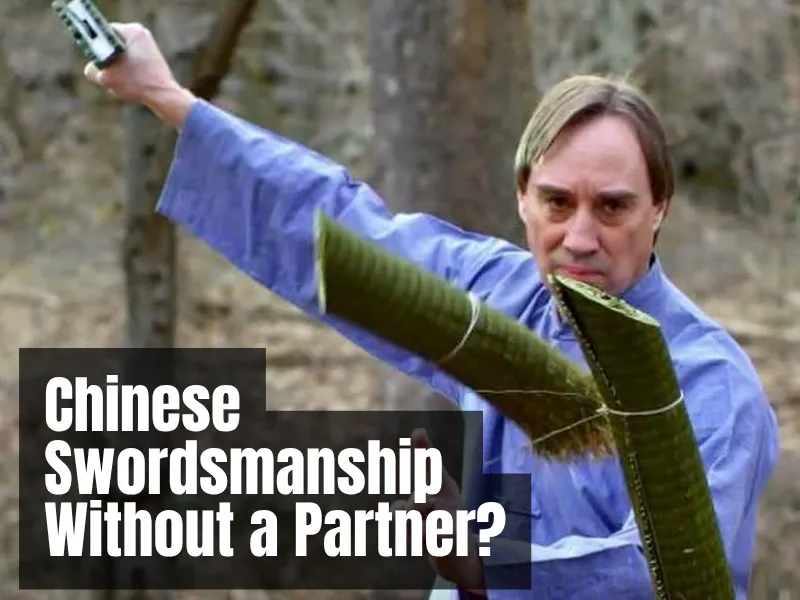
Beginners often start with relatively forgiving targets such as water-filled plastic bottles. Tatami and bamboo present more demanding cutting problems.
Each material exposes different errors.
A bottle may be knocked away, crushed or torn instead of being cut cleanly. Tatami and bamboo place greater demands on edge alignment, trajectory, commitment and the ability to continue the action through the target.
Test cutting does not prove that somebody can fight with a sword.
The target does not move, defend itself or hit back. You know exactly where it is and can prepare the cut without dealing with an incoming weapon.
What cutting can test is whether a particular action delivers a sharp blade through a physical target with sufficient alignment and structure.
That makes it useful, but specific.
It tests cutting. It does not test complete swordsmanship.
Sharp swords also introduce serious risks. Test cutting requires an appropriate weapon, a secure area and proper instruction in handling the sword, preparing the target and recovering safely after each cut.
Korean paper-cutting practice
Korean sword practitioners use hanging sheets of paper for accuracy and cutting practice. Known as Jong-I Begi, paper cutting is also used as a competitive discipline within Haidong Gumdo.
It looks simple, but the paper offers almost no resistance and is free to move. You cannot rely on smashing through it with brute force.
A successful cut requires accurate placement, suitable speed and clean edge alignment.
The result is difficult to argue with. The paper is either cut cleanly or it is pushed, torn or left hanging.
Competitions can increase the difficulty by changing the height and direction of the cuts or requiring several sheets to be cut in sequence.
Hanging paper creates an interesting stage between ordinary accuracy work and heavier test cutting. It provides objective feedback without requiring a beginner to immediately start cutting bamboo or rolled tatami.
What each training method actually develops
Every method has a particular job. Problems begin when we ask one exercise to prove something it cannot test.
None of these methods proves everything.
Together, they allow you to build and test different parts of the art.
Solo practice must retain its martial purpose
The reality is that most Chinese sword practitioners never progress beyond solo practice.
They may learn numerous cuts, combinations and forms but never attempt to apply those movements against another person. There is nothing wrong with enjoying forms or having no interest in sparring or competition.
The problem begins when the purpose of the movement is forgotten.
A sword is a tool designed for fighting. That does not mean modern practitioners need to pretend they are preparing for a battlefield. It means the movements were created to solve martial problems.
A thrust has a target. A deflection must remove an incoming weapon. A step changes the distance or angle between two people. A ready position must leave you capable of attacking, defending or moving.
Without that understanding, cuts finish where they look attractive, deflections become decorative circles and stances are judged by appearance rather than whether you can move from them.
Every solo drill should therefore have a clear context:
Where is the opponent?
What are they doing?
What line is their weapon travelling along?
What target am I attacking?
Why am I stepping in this direction?
Does my sword protect me while I act?
Where will I be if the first action fails?
This changes solo practice even when no opponent is physically present.
Accuracy training becomes an attempt to reach an opening. Pell work tests whether your structure survives contact. Cutting tests whether the action can deliver the blade through a target. Forms become connected tactical ideas rather than movements remembered in order.
A practitioner who trains this way will develop a better understanding of Chinese swordsmanship than someone who has collected numerous forms without considering what they are for.
That remains true even if they never fight.
What requires a partner?
A partner provides information that cannot be created alone.
You can reproduce the shape of a deflection, but not the experience of receiving an actual weapon. There is no incoming force to redirect, pressure to feel or need to judge whether an attack will reach you.
A partner allows you to test:
combative distance
timing
weapon contact
redirection of force
recognition of intention
adaptation when the expected action changes
decision-making under pressure
free swordplay
This is where partner training becomes an essential validation and experimentation tool.
You take a movement developed through solo practice and test it against a controlled attack. You change the distance, angle, timing and resistance until the movement either works, needs adapting or falls apart.
That failure is useful. It tells you what to work on next.
The process becomes:
Build the movement alone.
Test it with a partner.
Identify what fails.
Return to solo practice.
Test it again under greater pressure.
Partner work exposes the problem. Solo practice is usually where you put in the repetitions required to fix it.
Forms do not replace partner training
Traditional sword forms can develop coordination, transitions, balance and familiarity with a system’s movements. They can preserve tactical ideas and provide a structure for solo practice.
What they cannot provide is honest distance or unpredictable timing.
The imaginary opponent always attacks at exactly the right moment. They never withdraw, change the angle or strike while you are between movements.
A form can preserve an answer.
A partner tests whether you recognised the question.
When should partner training begin?
Partner work can begin once the student can perform the relevant movement with reasonable control.
The first exercise should not be sparring.
One person provides a slow, predictable attack while the other practises a single evasion or deflection. The speed, target and response are agreed in advance.
As control improves, more variables can be added:
Begin with one known attack.
Introduce a choice between two attacks.
Allow changes in distance.
Increase the speed.
Add a controlled counterattack.
Progress towards limited and then freer exchanges.
If the technique completely collapses, reduce the speed or complexity, restore the movement and then increase the pressure again.
Two beginners can work together if they have clear instructions, appropriate equipment and enough self-control to follow the exercise. A partner from HEMA, kendo or another weapons system may also be able to provide controlled attacks and resistance.
They do not need to adopt your system. They need to deliver the agreed action safely and consistently.
One training partner can eventually become the beginning of a study group.
So, can you learn Chinese swordsmanship without a partner?
Yes. You can learn a great deal, and solo practice is exactly where a beginner should start.
Accuracy drills, hanging targets, pell work and test cutting can make that practice demanding and objective. They expose poor control, weak alignment and vague targeting.
What they cannot do is behave like another swordsman.
A brick does not withdraw when it sees the thrust. A pell does not change its attack. A bottle does not control distance, and a sheet of paper does not try to hit you while you are cutting it.
If you never find a partner, training with clear martial purpose will still put your understanding ahead of most people practising Chinese sword forms.
If you eventually test those movements against another person, you will join the comparatively small number of Chinese sword practitioners willing to find out what actually survives.
Some movements will work. Others will need to be rebuilt.
That is the point.
The purpose of solo training is not to avoid the test.
It is to prepare for it.
Beginning without a training partner? The Academy’s Jianfa Blueprint begins with the solo foundations of Chinese straight-sword practice and introduces partnered exercises as those skills develop.


