
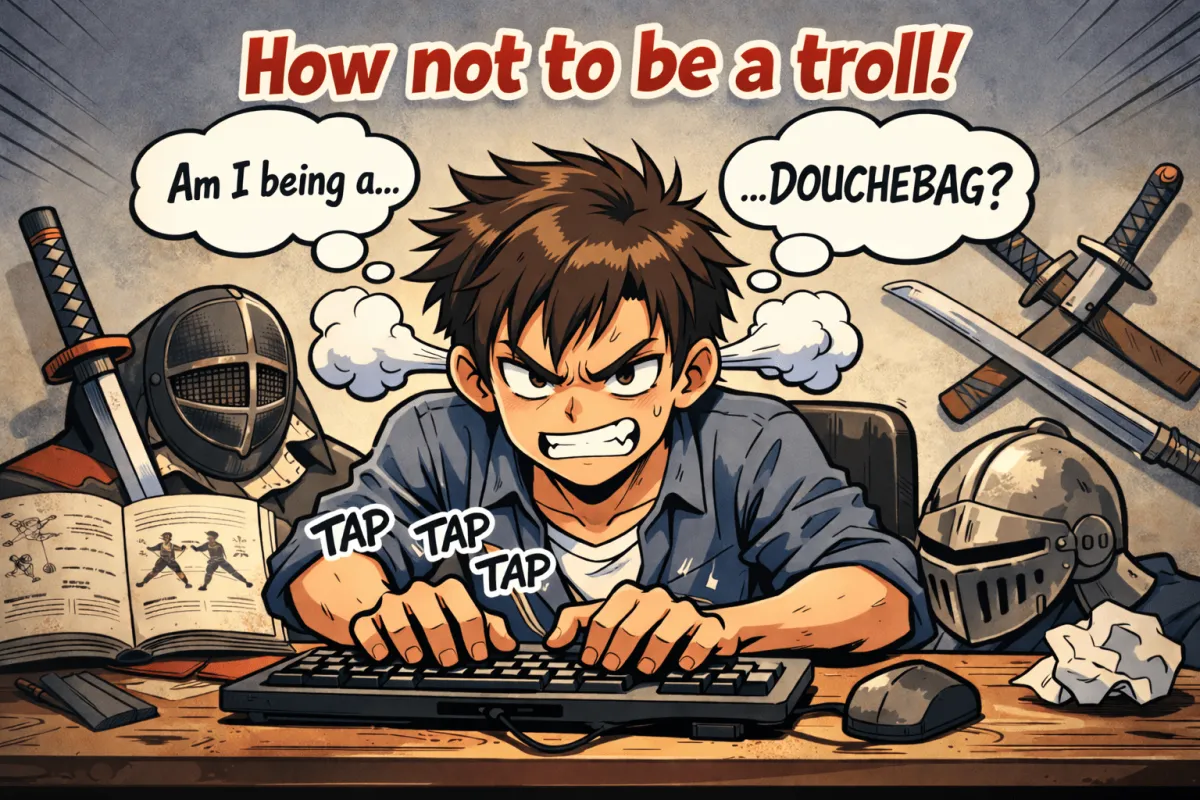
How Not to Be a Troll on Sword Social Media - Practical Etiquette for Sword Arts
Sword-related social media is a strange ecosystem. You get excellent material, genuine knowledge-sharing, and the occasional moment of brilliance.
You also get people who think typing loudly is the same thing as training deeply.
This is both a guide to not becoming that person, and a survival manual for when you inevitably meet one.
⚔️ PART 1 – HOW NOT TO BE A TROLL
1️⃣ Ask for context before assuming incompetence
If something looks odd to you, your first assumption should be that you’re missing context, not that the other person doesn’t know what they’re doing.
“Can you explain what you’re working on here?” beats “That’s wrong.”
Sword practice changes depending on intent, rule set, level of contact, experience, and purpose. What looks strange in isolation often makes perfect sense once you understand why it’s being done.
Experienced practitioners don’t mind questions. They do mind being corrected by people who haven’t asked what they’re actually looking at.
2️⃣ Separate “I don’t like it” from “it’s wrong”
Disliking something is not a critique. It’s a preference.
There’s nothing wrong with saying something doesn’t suit you, that you’d approach it differently, or that it doesn’t align with how you train. Those statements are honest, limited, and grounded in your own experience. They describe you, not the entire art.
Problems start when preference is dressed up as fact. “This would never work”, “that’s unrealistic”, “anyone serious knows better” aren’t tastes – they’re claims. And claims need backing up.
If you want to contribute meaningfully, evidence matters. Ideally that evidence is you actually doing the technique under pressure, testing it in sparring, or applying it in a bout. Even explaining clearly why something failed for you is far more useful than a blanket dismissal.
“X never works” adds nothing to the community. It shuts conversation down and replaces learning with noise.
Opinions without evidence aren’t insight. They’re just noise.
3️⃣ Don’t weaponise history you barely understand
Historical sources aren’t blunt instruments, and they aren’t cheat codes that let you win arguments online.
Most sword material was written for a specific audience, at a specific time, for a specific purpose. Military use, civilian self-defence, cultivation, examination systems - context matters. Ignore it and you misunderstand the source.
Most modern practitioners are also working from translations, partial translations, or second-hand commentary. Nuance gets lost. Terminology shifts. Things that were obvious to practitioners of the time can look vague or contradictory when lifted into the present without explanation.
Quoting a line from a manual you’ve skimmed doesn’t make you an authority. It just means you accessed a source. Understanding it is a different skill.
People who actually understand historical material handle it carefully. They talk about context, weapon, conditions, and purpose. They know the sources give clues, not universal answers.
People who don’t understand it tend to use it loudly.
Simple rule:
If your entire argument is “the manual says…”, and you can’t show how you’ve tested that idea in practice, you’re not citing history - you’re hiding behind it.
4️⃣ Don’t judge one level of play by the rules of another
One of the most common mistakes online is judging what you’re seeing through the wrong lens.
Light technical sparring, cooperative drilling, controlled free play, and tournament bouts are not the same activity. They don’t look the same, they don’t feel the same, and they don’t prioritise the same things.
Someone moving cautiously in a technical exchange isn’t “unable to fight”. They’re usually working timing, structure, or decision-making without risking injury. Judging that through a tournament lens misses the point.
The mistake cuts the other way too. Having done a bit of light sparring, or moving around with a friend in the garden, doesn’t put you in a position to critique someone who’s spent years dealing with heavier contact, higher pressure, and real consequences.
If you haven’t trained at the level you’re commenting on, you’re missing information. Commenting anyway doesn’t make you insightful – it just makes the gap obvious.
Context matters. Ignore it and you’re not analysing sword work, you’re projecting assumptions.
5️⃣ Equal access to comment doesn’t mean equal weight of opinion
Social media creates a dangerous illusion: because everyone can comment, everyone’s opinion carries the same weight.
It doesn’t.
Someone who has spent decades test cutting, sparring, fighting, and competing does not stand on equal footing with someone whose main experience is watching videos and arguing online.
Provoking a response isn’t contribution. Getting a rise out of someone doesn’t validate your practice or your understanding.
Debating an experienced practitioner doesn’t put you on their level. It just means you’ve found someone willing to reply.
⚔️ PART 2 - HOW TO DEAL WITH TROLLS (WITHOUT BECOMING ONE)
1️⃣ Learn the difference between disagreement and disruption
Disagreement isn’t a problem. It’s essential.
Testing ideas, challenging assumptions, and pressure-checking methods is how sword work improves. It’s how we learn in free play: you try something, it fails, you take the hit, you adjust.
Done properly, critical comments are valuable. They focus on the idea, not the person. They test rather than dismiss.
The problem starts with blanket statements. “That would never work.” “That’s just wrong.” Those don’t test anything. They shut learning down.
Context matters too. In free play, both people share the same pressure and constraints. Online, you’re often looking at a short clip stripped of intent and ruleset. Treating that fragment as the whole picture leads to bad conclusions.
Disruptive commenters aren’t engaging with any of this. They’re performing. Once you see that pattern, stop treating it like discussion.
2️⃣ Don’t feed the trolls
Trolls aren’t trying to be right. They’re trying to be seen.
If they can pull an experienced practitioner into a public back-and-forth, they feel elevated by association. In their head, the argument itself proves parity.
Long comment chains don’t correct this behaviour. They legitimise it.
Telling a troll they’re wrong or clueless rarely works. From their perspective, irritation equals success.
Once you recognise this pattern, the goal changes. It’s no longer about explaining anything. It’s about refusing to reward the behaviour.
Starve the interaction, and it usually collapses on its own.
3️⃣ Most of the time, ignoring the comment is the correct move
Ignoring bad comments is usually the smartest response – socially and mechanically.
Platforms reward engagement, not quality. The more you reply to a troll, even to correct them, the more visibility their comment gets. You don’t bury bad behaviour by fighting it. You amplify it.
The better response is to strengthen the surrounding content. Add something useful. Answer a genuine question elsewhere. Good contributions naturally push weak ones down.
That denies attention, improves the discussion, and ensures substance sits above noise.
4️⃣ Protect your time (it’s the one resource you don’t get back)
Most of us feel the urge to correct the entire internet.
Sometimes that comes from caring about the art. Sometimes from frustration. Either way, it’s expensive.
Everything online runs on attention economics. Attention is the currency, and time is the price. Disruptive people steal oxygen by pulling experienced practitioners into endless replies that go nowhere.
Every time that happens, something else doesn’t.
That time doesn’t go into training. It doesn’t go into working with peers or training partners who are genuinely engaged. It doesn’t go into refining your own understanding or building something useful.
Before engaging, ask yourself:
Will this improve the art?
Will it help the person?
Will it help those quietly reading?
Is it worth the time and attention it will cost?
Most of the time, the answer is no.
Your experience has weight because it was earned. That doesn’t mean it should be withheld, but it does mean it should be given deliberately.
Not every comment earns a reply.
Not every discussion is worth entering.
Protecting your time isn’t arrogance. It’s stewardship - of your practice, your peers, and the art itself.
⚔️ Final thought
Sword arts survived because people trained together, tested ideas under pressure, and respected experience earned through contact.
They didn’t survive because every opinion was treated as equal.
Train first.
Speak second.
Choose carefully where you spend your attention.


