How Chinese Weapons Rewired My Swordplay
Most of the time when we talk about the weapons in the Academy we describe them through history, lineage, technique, or battlefield function. What I wanted to do here was give a more personal take-how each weapon has actually changed my swordplay, what I noticed in my own practice, what surprised me, and what elements genuinely grabbed my interest.
Jian
For me, studying the Jian was a proper crash course in adaptability and fluidity. It’s slippery by nature and constantly forces you to change angles, slip out, and avoid being pinned. It really drove home the whole “swimming dragon” idea in a way that wasn’t just philosophical talk. The Jian made those old kung fu ideas-don’t fight, don’t sit in attack vs defense-actually make sense through experience, not theory.
With the Jian you start feeling attack and defence as active and passive phases rather than separate things, and that was huge for me. Instead of hard parries you slip and redirect, and that genuinely changed not just my sword work but the way I approached martial arts as a whole.
Dao
When I moved from being mostly Jian-based into Dao training, my whole attitude changed. Jian had made me evasive, happy to hang out on the outside. But Dao gave me the confidence to actually go forward. That “hungry dragon” idea suddenly meant something-you drive in with strength and intent but still keep flow.
Years of full-contact training had taught me to rely on speed and a kind of “naked aggression”, whereas the Dao helped me turn that into something more focused and naturally assertive. It added a layer of skilled, focused aggression to my swordplay and taught me to flow forward rather than flow away.
Miaodao
The Miaodao really built up my confidence in a new way. Because it’s a two-handed weapon with that extra length, you’re suddenly working at a greater distance, and that really sharpens your sense of range and timing. I initially thought it would feel slower because it’s a heavier, more powerful weapon, but it turned out to be surprisingly fast. It’s like it combines the raw power and forward drive of the Dao with some of the quick angle changes you’d expect from Jianfa, just at a longer range. It gave me a much better grasp of stepping, slipping offline, and managing distance while also boosting my confidence in handling more powerful attacks coming my way.
Dadao
Then when I got into the Dadao, it was fascinating because it kind of sits in between. It has the two-handed power that I got used to with the Miaodao, but it's also got a cutting range closer to the single-handed Dao. So you end up with this really interesting mix of speed and power, just without the extra reach of the Miaodao, but being a shorter blade it can deliver a heavier more robust cut.
It was one of the first times I focused on dealing with something like a bayonet, a long, pointy weapon, and the Dadao really excels at controlling that center line. It’s fast, adaptable, and powerful all at once, and it gave me a whole new appreciation for how to manage that central line in a fight. It was a really interesting weapon to study.
Spear and Bayonet
I’ve done the least freeplay with spear simply because it’s so overpowered. I mainly use it as a conditioning tool. If you saw the bayonet versus Jian bout Scott Rodell and I filmed, you’ll have noticed how quickly a couple of months of bayonet training can level the playing field against decades of sword experience. The spear is like that, but even more extreme. It’s hard to practise safely, but an eye-opening experience that gives an entirely different perspective on swordplay. The spear and bayonet are simple, highly effective thrusting weapons and great equalisers.
It does require serious control and gear though. At bare minimum the swordsman needs a proper mask and throat protection. The power of these weapons demands respect and good safety standards before training them in any active way.
Tengpai and Dao
Let’s just touch on the Tengpai and Dao-the shield and sabre. I haven’t done a lot with this combination for a pretty straightforward reason: it’s another overpowered combination.
Once someone’s tucked behind a shield, there just aren’t that many openings to work with, and you quickly understand why these setups were used in armies all over the world. They let someone with minimal training stand up to a much more experienced swordsman simply because there’s so little target left to hit.
So it’s not that it’s boring-let’s say it doesn’t really demand the same depth of study as the other weapons. It’s a practical, straightforward setup, but it doesn’t give you the same intricate learning curve as the other weapons I’ve been diving into.
Shuangshoujian
Now moving on to the Shuangshoujian - this is actually one of my current study weapons, so I’m just getting into it. It’s a really interesting piece because the grip lets you make these very short, quick changes, and the extra length makes it a formidable thrusting weapon. At the same time, you’ve got that two-handed power behind your cuts. It’s naturally like handling a longer, two-handed Jian that’s incredibly fast and adaptable.
Right now, I find it a bit intimidating to go up against because it’s a very different feel than the Miaodao. The Miaodao’s curved blade gives you bigger arcs and wider cutting angles, but with the Shuangshoujian, it’s like fighting a short spear that can also cut. It’s faster, sneakier, and more adaptable, so it’s adding a whole new element to my swordplay and pushing me to learn a different kind of versatility.
Hudiedao
And lastly, let’s talk about the Hudiedao, the butterfly swords. This is another one of my part-time study projects right now, and I haven’t had a huge amount of time to dedicate to it yet. But I’ve really enjoyed the training and the short sparring sessions I’ve done so far.
What I love about the butterfly swords is that you’re coordinating two weapons in tandem. You can use one to open up lines and the other to follow through with cuts, which is a really fun and intricate style to play with.
One thing that really surprised me was just how versatile they are. At first, I thought they’d mainly be for drawing cuts, chopping cuts, and thrusts. But it turns out they work really well for ballistic cuts too.
For example, those little flicking picuts you see in systems like Hung Gar or Wing Chun- I didn’t expect much power from them. But since each butterfly sword is weighted similarly to a single-handed Dao, they can deliver a surprisingly powerful and quick cut. It’s kind of like having the speed of Jianfa with the power of a Dao at very short range, and that was a really interesting discovery. I definitely want to explore it more in the future because it adds a whole new layer of coordination and creativity to my swordplay.
💭 Final thought
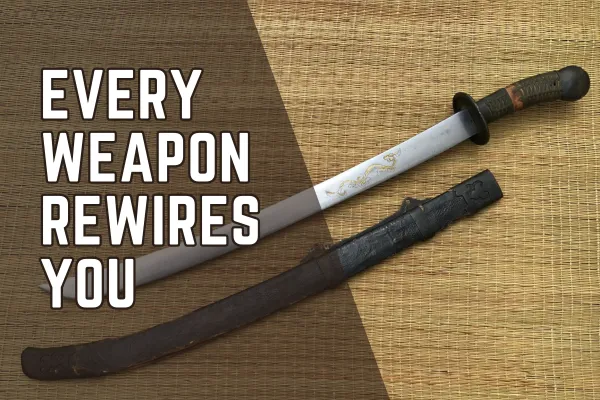
I’d really like to hear other people’s experiences with these. I honestly believe that studying different weapons doesn’t just make you better with that weapon-it reshapes your entire swordplay. Every system forces you to develop something different, and all of that comes back and improves your overall game.


